
Blog
Rosacea and Facial Redness: IPL vs Excel V+
Maybe it started as a flush that lingered after a glass of wine. Now the redness across your cheeks and nose stays put, and fine red lines show through every layer of concealer.
Light-based treatment is one of the most direct ways to calm that redness, because it works on the blood vessels underneath it.
This guide compares the two devices See Beyond Beauty uses for rosacea and broken capillaries, IPL and the Cutera Excel V+ laser, and explains why fall is the best season to begin.
What Causes Persistent Facial Redness?
Rosacea is a chronic inflammatory skin condition marked by facial flushing, persistent redness across the cheeks and nose, and visible broken capillaries, which are small blood vessels near the skin's surface that have widened and remain visible even when the skin is calm.
Those dilated vessels are the reason redness outlasts the trigger that set it off. Sun, heat, cold wind, alcohol, and spicy food can all bring on a flare, and repeated flares leave more vessels visible over time.
Creams can soothe the surface, yet they rarely reach the vessels themselves. Laser treatment for rosacea targets those vessels directly, and the sections below explain how each device does it.
How IPL Evens Out Diffuse Redness
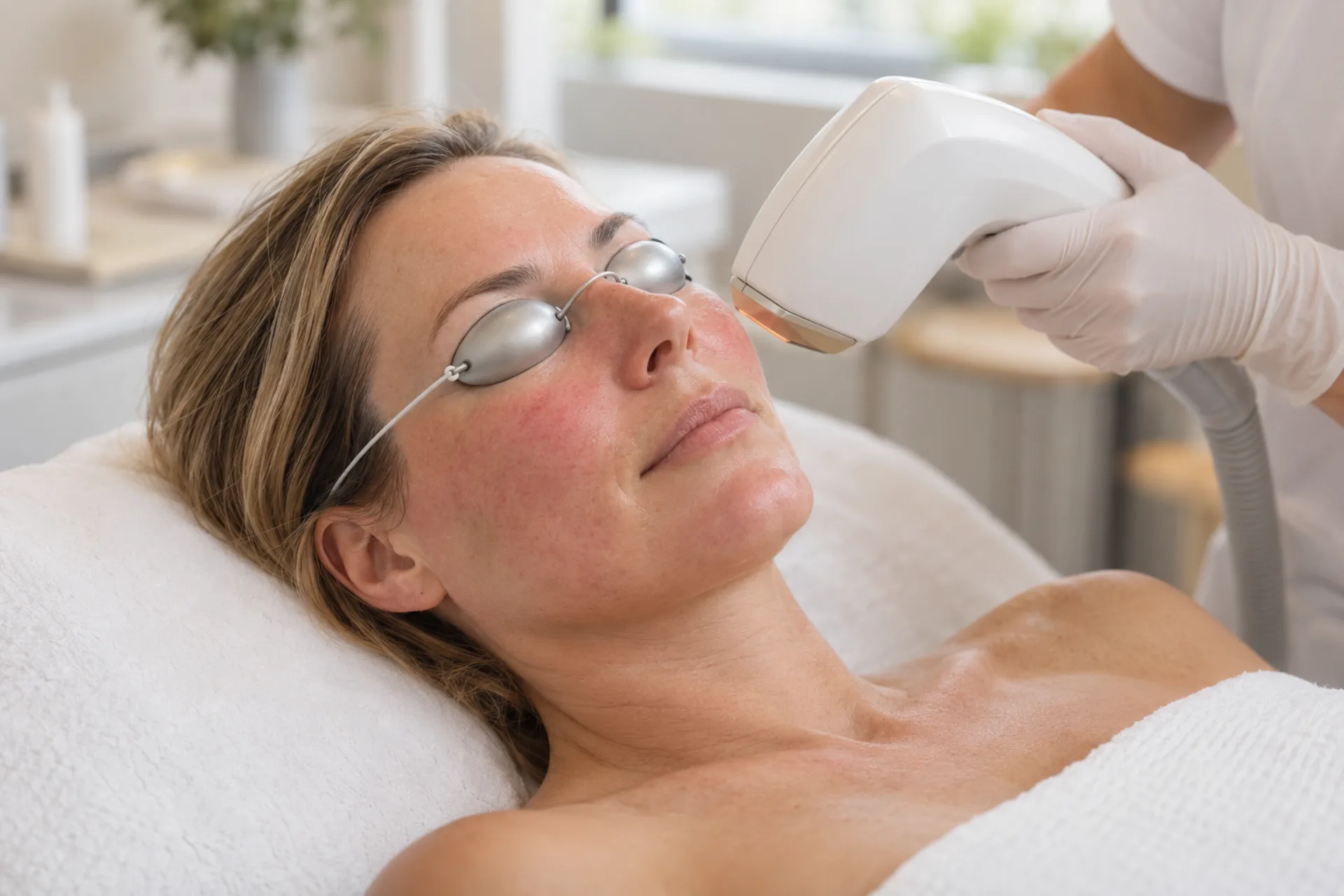
An IPL photofacial uses intense pulsed light, a broad spectrum of wavelengths delivered in short pulses. See Beyond Beauty treats with the StarLux (Icon) system from Cynosure.
That light targets two chromophores at once: hemoglobin in dilated blood vessels and melanin in sun-damaged pigment. The vessels absorb the energy and seal shut, which fades the background flush across the cheeks, nose, and chin.
Because IPL treats redness and brown spots in the same session, it suits faces where rosacea sits alongside years of sun damage. It also treats the chest and hands.
A full-face session takes about 20 to 30 minutes, and most patients feel a warm snap with each pulse. Treatment-related redness fades within hours to days, and you can wear makeup the next day.
How Cutera Excel V+ Targets Individual Vessels
The Cutera Excel V+ is a dual-wavelength vascular laser. It pairs a 532nm KTP wavelength for superficial redness with a 1064nm Nd:YAG wavelength that reaches deeper, larger vessels.
The Excel V+ works by selective photothermolysis. Each wavelength heats the red blood cells inside a targeted vessel while the surrounding tissue stays intact, and an integrated cooling system protects the skin surface throughout.
That precision lets a provider trace a single visible vein along the side of the nose. The Excel V+ also treats cherry angiomas, spider veins on the face and legs, and rosacea that has not responded fully to IPL or topical treatments.
IPL vs Excel V: Which Fits Your Redness?
The simplest way to frame IPL vs Excel V is breadth versus precision. IPL covers wide areas of even flushing, while the Excel V+ laser focuses energy on the vessels you can point to.
How IPL and Cutera Excel V+ compare for rosacea and facial redness:
| Factor | IPL (StarLux / Icon) | Cutera Excel V+ |
|---|---|---|
| Energy type | Broad-spectrum pulsed light | Two laser wavelengths, 532nm and 1064nm |
| Best for | Diffuse redness plus sun spots | Individual vessels, stubborn redness |
| Also treats | Brown spots on face, chest, hands | Cherry angiomas, leg veins, port wine stains |
| Session length | About 20 to 30 minutes, full face | 15 to 45 minutes, by area |
| Typical recovery | Redness fades within hours to days | Mild redness or bruising for 1 to 3 days |
| Rosacea series | 3 to 5 sessions, 3 to 4 weeks apart | 3 to 5 sessions |
Many patients do best with both devices. IPL clears the overall flush and pigment, then the Excel V+ follows up on the stubborn vessels that remain.
What a Treatment Series Looks Like
Rosacea responds gradually, so both devices are planned as a series. Most patients see their redness improve over three to five sessions, with results building after each visit.
Downtime stays minimal with either device. After an Excel V+ session, treated vessels can look darker for a short time before fading over two to four weeks, and you can return to normal activities right away.
Rosacea is a long-term condition you manage rather than erase. Maintenance sessions help control flare-ups, and IPL patients often return once or twice a year to offset ongoing sun exposure.
Why Fall Is the Best Time to Start
Light-based redness treatment and summer sun do not mix well. IPL should be avoided on tanned skin, because the light can target the melanin in a tan instead of the vessels you want treated.
See Beyond Beauty recommends avoiding sun exposure and self-tanners for two to four weeks before IPL. Both devices also call for daily SPF 30+ afterward.
Fall makes those rules easy to follow. A three-to-five session series started in October can wrap up over the winter, so your skin looks calmer by spring.
Cooler months also bring their own flare triggers, such as cold wind outdoors and dry heat indoors. Starting treatment now lets you get ahead of that winter flushing.
Building Your Rosacea Treatment Plan
Choosing between IPL and Excel V+ starts with a skin assessment. Your provider maps which redness is diffuse, which comes from distinct vessels, and whether pigment needs attention too.
Dr. Joon Lee supervises every treatment plan, and many plans pair devices. PicoSure can address deeper brown pigment, while LED red light therapy calms inflammation with no downtime.
Because rosacea care continues after the first series, many patients spread sessions and maintenance across the year through the membership program.
Key Takeaways
- Persistent facial redness, flushing, and visible broken capillaries are common signs of rosacea, and light-based treatments target the dilated blood vessels behind them.
- IPL uses broad-spectrum light to even out diffuse redness and sun damage in the same session, across the face, chest, and hands.
- Cutera Excel V+ is a dual-wavelength vascular laser that targets individual visible vessels and stubborn redness with precision and integrated cooling.
- Rosacea typically improves over three to five sessions with minimal downtime, followed by maintenance sessions to manage flare-ups over the long term.
- Fall and winter are ideal starting seasons because lower sun exposure reduces pigment risk, and a physician assessment determines which device, or combination, fits your skin.
Related Resources
Explore the treatments referenced in this guide:
- IPL photofacial — broad-spectrum light for diffuse redness and sun damage in one session
- Cutera Excel V+ — dual-wavelength laser for visible vessels and stubborn rosacea
- PicoSure — picosecond laser for deeper, stubborn pigmentation
- LED red light therapy — calming, no-downtime light therapy that reduces inflammation
- Dr. Joon Lee — the physician who supervises each treatment plan
- Membership program — spread a treatment series and maintenance across the year
Treating Rosacea in Scarsdale or Greenwich This Fall?
See Beyond Beauty builds medically guided rosacea and redness plans around your skin and a physician's assessment, at two locations in Scarsdale NY and Greenwich CT.
Book a consultation to learn whether IPL, the Cutera Excel V+, or a combination of both fits your path to calm, even-toned skin.

Calm, Even-Toned Skin
Book Your
Consultation
Meet your provider, map your redness, and plan whether IPL, the Cutera Excel V+, or a combination of both fits your skin this fall.